Rewrite (apply a critique pack)
paperful rewrite takes an existing critique pack and
proposes locatable edits. The Advanced workbench labels this Suggest
edits so it is not read as “the AI rewrites my paper.” It is
apply-from-critique, not a paper generator. It does not re-run critique,
does not overwrite the source file, and does not write to the reference
manager.
Default area is style (hygiene: Vale, glossary/acronyms, prose). Other
areas (cites, structure, comments) are opt-in. Outputs are an edit plan
always, plus optional sidecar text and office files: Word tracked-changes,
OpenDocument (.odt), and/or PDF. --output tracked follows the source
suffix (Word spine for markdown / PDF / HTML / RTF). --output odt and
--output pdf can be requested for any source.
Paperful does not vendor Paper Orchestra, ARIES, or XtraGPT. Docs credit the patterns: a worklog, align-then-generate, selected-span prompts.
CLI
--pack, --item, and --file locate the critique pack. --file with
--pack is allowed: the pack supplies findings; --file is the manuscript
to edit.
uv run paperful rewrite --pack state/critiques/file-draft/20261027T...
uv run paperful rewrite --file ./draft.docx
uv run paperful rewrite --item KEY
uv run paperful rewrite --file ./draft.docx --area cites --area structure --comments substantive
uv run paperful rewrite --pack PATH --output edits --dry-run
Exit 1 if no pack exists. Never calls
build_critique.--area(repeatable):style,cites,structure,comments, orall.--output(repeatable):edits,sidecar,tracked,odt,pdf.--comments:off(default),substantive,all— reviewer/MARG notes as Word comments.--dry-runprints the plan and writes nothing.--format json→ agent envelope. Phase lines on stderr.Not in
paperful all.paperful jobs→ completeness.
Packs land in state/rewrites/<critique-id>/<stamp>/ as plan.json
(paperful.rewrite.plan.v1), pack.md, and pack.json
(paperful.rewrite.pack.v1). --output tracked writes tracked.docx /
tracked.pptx / tracked.odt matching the source (markdown and other
text sources get a Word spine). --output odt always writes tracked.odt
(native copy when the source is ODT; otherwise a paragraph spine).
--output pdf writes tracked.pdf (Playwright Chromium print of the
applied text). Comments become numbered markers plus a Comments page and
PDF sticky notes. Library PDFs are read-only; output is always new files.
Areas
Id |
Default |
What it does |
|---|---|---|
|
on |
Vale, glossary/acronyms, |
|
off |
Bibliography locators. Cite keys only from the extract/pack. Retracted / withdrawn / EoC cites are comments, never deletes |
|
off |
Missing section headings, float caption/mention, missing ethics/data mentions. No invented results |
|
off |
Suggested findings and reviewer notes as comments on a unique span or heading |
Always skip: dismissed rows, direct quotations, overlap, AI-tells / Binoculars, PaperGuard, file-health, metrics summaries, identity lint, non-actionable praise.
LLM is required only when a selected area still has findings without a
deterministic replacement. Style-only glossary/Vale substitutions run with
[llm] off.
Config
[rewrite]
areas = ["style"]                 # style | cites | structure | comments | all
outputs = ["edits", "tracked"]    # edits | sidecar | tracked | odt | pdf
comments = "off"                  # off | substantive | all
max_edits = 80
timeout_s = 0                     # 0 → max([llm].timeout_s, 600)
openxml_audit = false             # optional extra: uv sync --extra openxml (docx/pptx/odt)
openxml_audit_policy = "warn"     # warn | fail

[[rewrite.specialists]]
id = "style"
model = ""                        # empty → [llm].model; may be an XtraGPT Ollama tag
prompt = "default"                # or prompts/rewrite-style.md
[[rewrite.specialists]] is separate from [rewrite].areas (enabled ids)
because TOML cannot use the same key for a string list and an array of tables.
Optional area model: an Ollama tag from Xtra-Computing/XtraGPT-GGUF. Default
remains [llm].model. ICLR/ReviseQA criteria are ML-shaped; ocean/policy
drafts should not assume them. See llm.md.
Honesty
No new numbers, experiments, or cite keys unless they already appear in the extract, the finding, or the pack.
Unflagged text is unchanged.
Body edits must not mention Paperful, the critique pack, or “the reviewer”.
Weak alignment → skip or a Word comment, not a guessed rewrite.
Tracked-changes v1 uses stdlib OOXML for
.docx. Unique paragraph match only; miss → skip. Complex Word (fields, existing revisions, text boxes) is not round-tripped..pptx/.odtget a copy with unique-span replacements (not Word revision markup; comments stay in the edit plan).--output odton a non-ODT source builds a paragraph OpenDocument spine the same way.--output pdfprints the applied text with numbered comment markers, a Comments page, and PDF sticky notes (not Word tracked-changes). Optional[rewrite].openxml_auditruns openxml-audit (Microsoft Open XML SDK port plus ODF adapter;paperful[openxml]) on office files and reports errors not already on the source. Word-authored drafts can fail the SDK onstylesWithEffects; those are ignored.failexits 1 when rewrite introduced a new issue. Stdlib structure checks (comment ranges, Ignorable prefixes, slide/content XML, PDF header) always run on those outputs. Paperful does not write.xlsx; forensics only reads tables.
Workbench
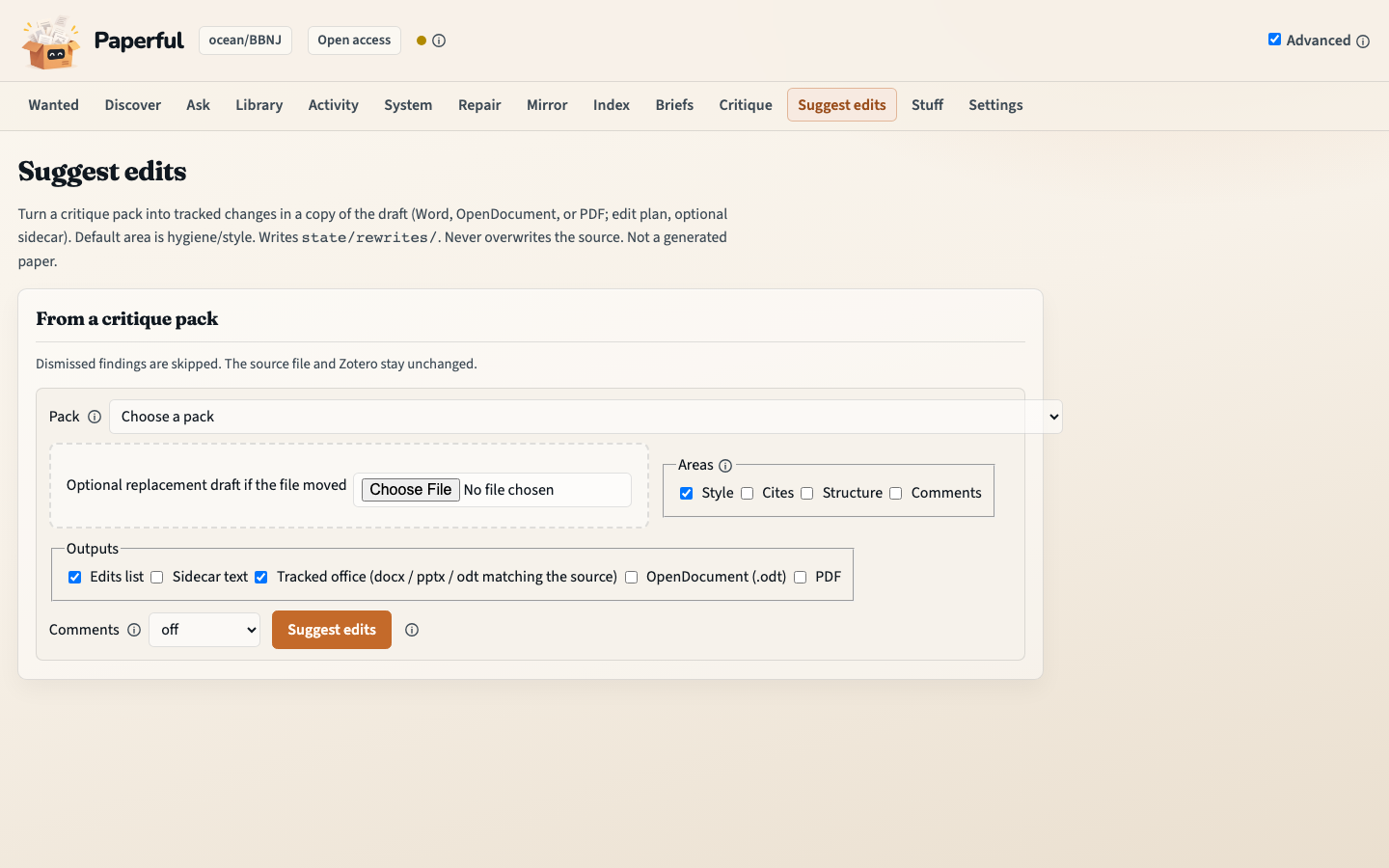
Advanced Suggest edits (next to Critique; CLI is still paperful rewrite):
pick a recent critique pack, optional replacement draft, area/output/comments
controls, download the result. With no pack on disk, the page shows only
Run Critique first with an Open Critique link.