Critique (local manuscript pack)
paperful critique writes an evidence-backed Markdown pack for a manuscript
you already have: a mirrored library --item, or a --file / workbench
upload. Deterministic checkers always run. Optional review lanes are a
separate suggested extra and can run together. There is no score, grade,
or accept/reject.
This is a pre-submission / reading-aid pack, not a referee and not Google
Deep Review. It does not upload the manuscript and does not call a similarity
API. Overlap is against your library text already on disk. Suggested
review lanes default to that extract (and optional local RAG). The
context-web lane is the only critique path that may query OpenAlex /
SearXNG, and only when you opt in.
What it checks
Deterministic checkers always run (no model). Checked findings carry a
quote and a page / paragraph / slide loc when one exists. Heuristic AI-prose
tells always run too, as suggested info — they are not an LLM and not
proof of authorship. Optional review lanes (--lane reviewers / marg /
adversary / outline / claims / verify / context / context-web; --llm and --advanced are aliases) and
--ai-model are separate suggested extras. Optional --vale house-style
alerts are checked. Optional --forensics runs sibling CLI paperguard
and records suggested findings. Paperful does not vendor MARG, ScholarPeer,
or PaperGuard detectors; docs credit the patterns.
Area |
Lane |
Codes (examples) |
|---|---|---|
File health |
checked |
|
Structure |
checked |
|
Identity / integrity |
checked |
lint codes; PPS / retraction flags as |
Bibliography |
checked |
|
Cited-work status (online) |
checked |
|
Floats |
checked |
|
Acronyms |
checked |
|
Abstract numbers |
checked |
|
Reproducibility / ethics |
checked |
|
Checklists |
checked |
|
Stats |
checked |
|
Prose |
checked |
|
Metrics |
checked |
|
Heuristic AI-prose tells |
suggested |
|
Library text overlap |
checked |
|
House style (optional Vale) |
checked |
|
Forensics (optional PaperGuard) |
suggested |
|
Offline (PAPERFUL_OFFLINE=1 or no HTTP client): skip Crossref/OpenAlex rows and
emit doi_status_skipped_offline / identity_skipped_offline. PPS fingerprints
still run when state/pps/fingerprints/ or [screen].fingerprint_dir has CSV/JSON
(see screen); warm the cache once with paperful screen --refresh.
When online, tortured-phrase and other PPS fingerprints run on the critique
extract for both --item and --file (same [screen].detectors and
tortured_min as screen).
Overlap is flags to review, not a plagiarism verdict. Boilerplate that appears in many library texts is dropped. Do not narrate misconduct.
CLI
--item KEY and --file PATH are mutually exclusive. -C (or --library
for the whole library) is the corpus for the overlap and context lanes. --file also accepts
csv / xlsx / xls so PaperGuard can scan a table without a manuscript
wrapper (xlsx/xls have no text extract; checkers see an empty document).
uv run paperful critique --item KEY -C "My Collection"
uv run paperful critique --file ./draft.docx -C "My Collection"
uv run paperful critique --file ./draft.pdf --lane reviewers
uv run paperful critique --file ./draft.pdf --llm
uv run paperful critique --file ./draft.pdf --llm --reviewer line-editor
uv run paperful critique --file ./draft.pdf --lane marg
uv run paperful critique --file ./draft.pdf --lane adversary
uv run paperful critique --file ./draft.pdf --lane outline
uv run paperful critique --file ./draft.pdf --lane claims
uv run paperful critique --file ./draft.pdf --lane verify
uv run paperful critique --file ./draft.pdf --lane reviewers --lane marg --grobid
uv run paperful critique --file ./draft.pdf --lane context
uv run paperful critique --file ./draft.pdf --lane context-web
uv run paperful critique --file ./draft.pdf --no-llm --no-advanced
uv run paperful critique --file ./draft.pdf --no-llm   # drop reviewers (alias)
uv run paperful critique --file ./draft.pdf --ai-model
uv run paperful critique --file ./draft.pdf --vale
uv run paperful critique --file ./draft.pdf --forensics
uv run paperful critique --item KEY --llm --force      # LLM despite identity lint
uv run paperful critique --item KEY --apply            # child note; needs --item
uv run paperful critique --item KEY --show-dismissed
uv run paperful critique dismiss FINDING_ID
uv run paperful critique dismiss FINDING_ID --critique-id KEY
--dry-run prints findings and does not write state/critiques/. --apply
posts a tagged child note only for a library --item. Uploads stay disk-only.
--lane NAME (repeatable: reviewers, marg, adversary, outline, claims, verify,
context, context-web)
selects suggested review lanes for this run. [critique].lanes is the config
list; when it is empty, [critique].llm / [critique].advanced still map to
reviewers / marg. --llm / --no-llm and --advanced / --no-advanced
are aliases that add or remove those two ids. --grobid / --no-grobid
override [grobid].enabled and affect MARG-S / claims / verify PDF chunks
(--grobid still attempts the sidecar even when [grobid].enabled is false,
same as extract-sections). --ai-model turns the
Binoculars extra on for this run (git overlay; there is no
--no-ai-model; set [critique].ai_model = false in config). --vale turns the Vale house-style
pass on for this run (there is no --no-vale; set [critique].vale = false).
--forensics turns the PaperGuard subprocess on for this run (there is no
--no-forensics; set [critique].forensics = false).
-C is the overlap / “cited but not in library” corpus. paperful jobs lists
critique under completeness.
Not in paperful all.
Packs land in state/critiques/<id>/<stamp>/ as pack.json
(paperful.critique.pack.v1) and pack.md. <id> is the library item key
or file-<filename-stem> for --file / uploads, so re-running the same draft
keeps dismissals. Dismissals are state/critiques/<id>/dismissed.jsonl.
Dismissed rows stay in JSON and are omitted from pack.md unless
--show-dismissed.
Human CLI prints elapsed phase lines (extract, checkers, cited-work DOI
counts, overlap, each reviewer, extras) so a long run is not silent until
the pack. --format json keeps stdout as the envelope only; a spinner still
goes to stderr on a TTY. Run report: state/runs/<stamp>-critique.json.
pack.json always has findings, overlap, metrics, and llm. metrics
holds readability, lexical diversity, and the AI-tell summary (also rendered
as a Metrics section in pack.md). pack.md leads with an Incomplete lanes
banner when a requested review lane skipped, then reviewer notes, counts,
metrics, Critical path (checked findings that are not hygiene, majors
first), Outline (when --lane outline ran), Claims (when --lane claims ran), Suggested, and Hygiene
(Vale, acronyms, prose metrics, AI-tell codes). JSON findings is unsplit.
llm is null until a review lane runs;
then it records lanes (ordered ids), a deprecated mode string
(default / marg / both / adversary / outline / claims / verify / context /
context-web) derived from that
set, model, prompt_sha, provider, optional narrative, a reviewers
list (per-id model, skip reason, Markdown note, including marg-experiments
/ marg-clarity / marg-impact, adversary, outline, claims, verify-*, and
context / context-web when those
lanes ran), optional marg stats (parser is grobid or extract;
rounds, calls, skipped; optional grobid_skipped; optional aspects),
optional adversary stats (calls, skipped), optional outline stats
(calls, skipped), optional claims stats
(parser, calls, skipped), optional verify stats (parser, segments,
calls, skipped), and optional
context stats (search_enabled, backends, rag_skipped,
search_skipped). Top-level outline is the section skeleton when that lane
ran. Top-level claims is the intra-doc ledger when that lane
ran. ai_model and vale appear only when those extras ran
(skip reason or alert counts).
Input formats
Kind |
How |
Loc |
|---|---|---|
|
existing PDF text layer |
page |
|
UTF-8 |
paragraph |
|
BeautifulSoup |
paragraph |
|
zip + XML |
paragraph |
|
control-word strip |
paragraph |
|
slide XML |
slide |
|
optional |
paragraph |
Unknown binaries are refused. Nothing is sent to Google Docs or Word. If
extract yields too little text, needs_ocr / empty_extract and checkers that
need body text stop.
Workbench uploads are copied under state/critiques/uploads/<stamp>-<safe>/
(same basename hardening as other GUI uploads; 40 MB cap). They never write
out/ or Zotero unless you later attach the file yourself.
Review lanes (--lane / [critique].lanes)
Suggested extras. Checkers always run. Lanes are additive and may be
combined. Identity mismatch refuses all review lanes unless --force.
Each lane needs [llm].enabled; otherwise the pack records
skipped: llm_disabled and still writes. Paperful does not vendor
allenai/marg-reviewer or ScholarPeer
/ open-scholar-peer.
Id |
Alias |
What it does |
|---|---|---|
|
|
Independent |
|
|
MARG-S-style multi-agent (experiments / clarity / impact) |
|
— |
Validity red-team (alternative explanations, validity, degrees of freedom, falsifiers, missing negatives) |
|
— |
Plan review: section skeleton, claim/warrant/scope/evidence pressure. Not a finished-manuscript verdict |
|
— |
Intra-doc claim ledger: extract core claims, bind to methods/results/limitations spans |
|
— |
Section swarm: density budget, sequential verify, local synthesis (not Deep Review) |
|
— |
ScholarPeer-inspired: summary, library historian, baseline scout, Q&A |
|
— |
Same pipeline; literature/baseline may query OpenAlex / optional SearXNG |
[critique]
lanes = ["reviewers", "marg", "claims"]
When lanes is non-empty, [critique].llm and [critique].advanced are
ignored. When it is empty, those bools still map to reviewers / marg.
--no-llm --no-advanced with no --lane is checkers only.
--reviewer ID still subsets only [[critique.reviewers]]. Orthogonal extras
(--vale, --ai-model, --grobid, --forensics) are not lanes.
Optional reviewers (--lane reviewers / --llm)
Follows llm.md: local Ollama by default, egress notice, grounded in
the extracted text already on disk plus the checked finding list. No web
search. Comments are lane=suggested only. Ungrounded spans are dropped.
Direct quotations are not rewritten; comments on quoted spans are dropped.
Never emits scores.
Default is one reviewer ([llm].model + builtin JSON prompt). Add more
with [[critique.reviewers]] — each row has id, optional model (empty
inherits [llm].model), and prompt (default or a path relative to the
config file; if that file is missing, shipped prompts under the Paperful
install/repo prompts/ directory are used). --reviewer ID (repeatable) runs
a subset. A Markdown prompt file yields a Reviewer note at the head of
pack.md; the builtin prompt still returns JSON comments as suggested findings.
One LLM call per reviewer. Shipped Markdown personas (ids are suggestions):
id |
prompt file |
role |
|---|---|---|
|
|
JSON comments + questions (builtin) |
|
|
Prose, voice, and line craft |
|
|
Argument and foundational pressure |
|
|
OpenReviewer-style general review (local |
Legacy paths prompts/critique-reviewer-{2,3,5}.md still resolve to the same
files. The theatrical critique-reviewer-4.md persona was removed; if you
copied it into paperful-data, drop that [[critique.reviewers]] row (use
--lane adversary instead).
No-LLM users still get the pack (checkers, metrics, heuristic tells).
Optional adversary (--lane adversary)
Additive suggested lane. One JSON turn over the extract and checked findings:
alternative explanations, selection / construct / external validity, researcher
degrees of freedom, what would falsify the core claim, and missing negative or
comparison cases. Same grounding and no-score rules as reviewers. Cap:
adversary_max_comments (default 12). Timeout is [llm].timeout_s.
Optional outline (--lane outline)
Additive suggested lane. Treats the extract as a plan, not a finished
paper. Deterministic heading detection builds a section skeleton (word counts;
outline_thin when a named section has almost no body). Excerpt packing keeps
every section in budget instead of head-plus-tail. One JSON turn pressures
claim, warrant, missing sections the argument needs, scope vs length,
allocation, planned evidence, audience, and sequence. Codes: outline_claim,
outline_warrant, outline_gap, outline_scope, outline_balance,
outline_evidence, outline_audience, outline_sequence. Same grounding and
no-score rules as reviewers. Cap: outline_max_comments (default 12). Timeout
is [llm].timeout_s.
pack.md has an Outline section. When this lane ran, missing_section and
missing_mention move to Hygiene (JSON findings stay the same). Combining
with line-editor, openreview, or marg still reviews the extract as if it
were a paper.
uv run paperful critique --file ./outline.docx --lane outline -C "My Collection"
Optional claims (--lane claims)
Additive suggested lane. One JSON turn extracts core claims from abstract /
results / conclusion (plus a short methods sketch), then deterministic
content-word overlap binds each claim to methods / results / limitations
spans in this extract. Status is supported, thin, or unsupported.
An optional second turn may only downgrade a label (never invent a
supporting span). Codes: claim_thin, claim_unsupported_in_text. Supported
rows stay in the pack["claims"] ledger and a Claims section in
pack.md; they are omitted from Suggested. Honesty: “not supported in this
extract,” never “the claim is false.” Caps: claims_max (default 8),
claims_max_comments (default 16), claims_timeout_s (0 → [llm].timeout_s).
Optional GROBID heading units when --grobid / [grobid].enabled.
Optional verify (--lane verify)
Additive suggested lane inspired by Google Deep Review / PAT’s segment-and-verify pipeline. Paperful does not upload the manuscript and does not call Gemini or Google Search. Local models will not match Deep Think proof recall.
Python segments heading units (overlapping logical groups), assigns a
light / medium / heavy density budget (proof/equation-dense sections get
a second attack turn), verifies each segment sequentially against the full
excerpt, then synthesizes. Comments that invent a title or DOI not in the
extract, bibliography, or Crossref/OpenAlex status cache are dropped; a DOI
with no cache hit may record verify_cite_unchecked (no live HTTP). Codes:
verify_logic, verify_math,
verify_inconsistency, verify_gap. Caps: verify_timeout_s (0 →
max([llm].timeout_s, 600)), verify_max_comments (default 16),
verify_max_segments (default 8). Wall-clock overrun records skipped: timeout plus incomplete-lane rows for unfinished segments. Optional GROBID
heading units when --grobid / [grobid].enabled. Literature search stays
--lane context-web.
Optional MARG-S (--lane marg / --advanced)
Additive suggested lane inspired by MARG-S
(D’Arcy et al., arXiv:2401.04259;
allenai/marg-reviewer, Apache-2.0).
Paperful does not vendor that repo. Python orchestrates JSON turns with a
leader, chunk workers, and one expert per aspect group, then a refine pass.
Default aspects are experiments, clarity, and impact. Set
[critique].advanced_aspects to a subset or to add theory (proof/lemma
gaps), policy (legal warrant / instrument fit), or evidence-base
(survey/doctrinal coverage). Do not enable all six by default — they share
advanced_timeout_s. Same grounding and no-score rules as reviewers.
Local models will not match hosted proof-checking recall.
MARG PDF chunks prefer the optional GROBID TEI cache (process_pdf /
tei_to_markdown_pages, same as extract-sections). Scans,
non-PDFs, and sidecar errors fall back to ExtractedDoc and record
marg.parser = "extract" plus grobid_skipped. Checkers never require GROBID.
Remote GROBID prints the same yellow egress notice as extract-sections
(PDF bytes leave this machine). Caps: advanced_max_rounds,
advanced_max_workers, advanced_max_comments, advanced_refine,
advanced_timeout_s (0 → max([llm].timeout_s, 600)). A duplicated
leader broadcast is a hard stop (skipped: loop). A wall-clock overrun
records skipped: timeout rather than hanging a workbench job.
Optional context (--lane context / --lane context-web)
Additive suggested lane inspired by ScholarPeer (Goyal et al., arXiv:2601.22638). Paperful does not vendor that framework or community skill packs. The pipeline is summary → historian → baseline scout → multi-aspect Q&A → synthesis. Same grounding and no-score rules as reviewers. This is not ScholarPeer parity and does not emit venue scores.
context retrieves only from the local RAG index (collection / library
scope when -C / --library loaded items). Missing index records
rag_skipped and continues on the extract.
context-web uses the same pipeline and may query OpenAlex, then optional
SearXNG when [searxng].base_url is set. A yellow egress notice prints.
PAPERFUL_OFFLINE=1 skips those calls and records search_skipped: offline.
Venue filters are not hard-coded to ML conferences. Caps:
context_timeout_s, context_max_comments, context_max_hits.
Optional AI-text extra (--ai-model / [critique].ai_model)
Requests a Binoculars-style score
(Hans et al., ICML 2024). Install
with uv pip install "binoculars @ git+https://github.com/ahans30/Binoculars.git"
(git overlay, not a locked extra; pulls torch). Off by default. A later
uv sync without --inexact uninstalls it. If the extra
is missing, the pack records ai_model_unavailable (suggested / info) and
still keeps the heuristic tells. Scoring stays Hugging Face-offline; Falcon-7B
must already be in the cache. Never treated as proof of authorship.
House glossary (state/glossary/)
Canonical acronym expansions live in state/glossary/<slug>.json
(paperful.glossary.v1), not in the Title Case allowlist from
paperful acronyms. Critique reads every JSON file in that directory when
[critique].glossary is true (the default). Empty or missing files add no
findings.
{
  "schema": "paperful.glossary.v1",
  "scope": "ocean/BBNJ",
  "entries": [
    {
      "token": "BBNJ",
      "expansion": "Areas Beyond National Jurisdiction",
      "aliases": [
        "Maritime Area beyond national jurisdictions",
        "marine areas beyond national jurisdiction"
      ]
    }
  ]
}
acronym_expansion_mismatch (warn) fires when a parenthetical expansion for
a listed token is close to the canonical form or an alias but not the
canonical text. acronym_phrase_mismatch (info) slides a window over the
body (stdlib difflib, default [critique].glossary_similarity_min = 0.88)
and flags near-misses of the long form even without the acronym. Exact
canonical wording is silent. Direct quotations are skipped. Findings suggest
the canonical string; they do not rewrite the manuscript.
paperful glossary validate checks the files. paperful glossary export-vale
prints (or --out writes) a Vale Substitution fragment from exact
aliases. Vale cannot fuzzy-match; keep the glossary for similarity, and merge
the export into your .vale.ini styles if you also run --vale.
Set [critique].glossary = false to skip the checker. [critique].glossary_dir
is a directory under state_dir (default glossary).
Optional Vale (--vale / [critique].vale)
House-style lint via Vale on the already extracted
manuscript text (not the original .docx / PDF markup). Paperful does not
install Vale, does not put it in the Compose image, and does not run
vale sync. You install the binary, keep your own .vale.ini and styles, and
opt in. paperful doctor reports whether vale is on PATH (amber if missing;
not fatal).
Set [critique].vale_config to that ini (path relative to the paperful
config). If unset, Paperful looks for .vale.ini next to the paperful config
file only — not $HOME and not Vale’s global config (--no-global).
[critique].vale_min_alert_level (suggestion / warning / error) and
vale_timeout_s (default 60) apply to that subprocess. Missing binary, missing
config, or a Vale crash records vale_unavailable / vale_no_config /
vale_failed (checked / info) and the rest of the pack still runs. Alerts
map to vale_<check> findings (lane=checked, source=vale). Vale suggestion
is paperful info; Vale warning and error are warn, never major. More
than 100 alerts yields vale_truncated. Built-in prose checkers
(long_sentence, hedge_words, passive_voice) still run; overlap with Vale
rules is expected.
Optional forensics (--forensics / [critique].forensics)
Subprocess wrapper around sibling PaperGuard
(paperguard scan). Paperful does not install PaperGuard and does not vendor
its detectors. You put paperguard on PATH and opt in. paperful doctor
reports whether it is on PATH (amber if missing; not fatal). Missing binary,
no scannable file, or a crash records paperguard_unavailable /
paperguard_no_input / paperguard_failed (suggested / info) and the
rest of the pack still runs.
--file PATH scans that file. --item KEY scans the resolved PDF plus
*.csv / *.xlsx / *.xls in the same directory. When the item has a DOI
and the run is online, Paperful passes --doi for PaperGuard metadata
cross-checks. Default detectors only — no --ml-check, --llm-review, or
paper-mill graph flags. Hits map to paperguard_<detector_id> findings
(lane=suggested, source=paperguard). PaperGuard NOTE is paperful info;
CONCERN is warn; SUSPICIOUS and CRITICAL are major. PASS rows are dropped.
More than 100 hits yields paperguard_truncated. PaperGuard’s integrity_score
is not copied into the pack. pack.md has a Forensics (PaperGuard)
section (anomalies to investigate, not a verdict); the same rows also appear
under Suggested. A copy of the raw report is paperguard.json next to
pack.json. Timeout: [critique].forensics_timeout_s (default 300).
The wrapper passes --lang en (and PAPERGUARD_LANG=en); some detector
summaries may still arrive in PaperGuard’s bundled language.
Workbench
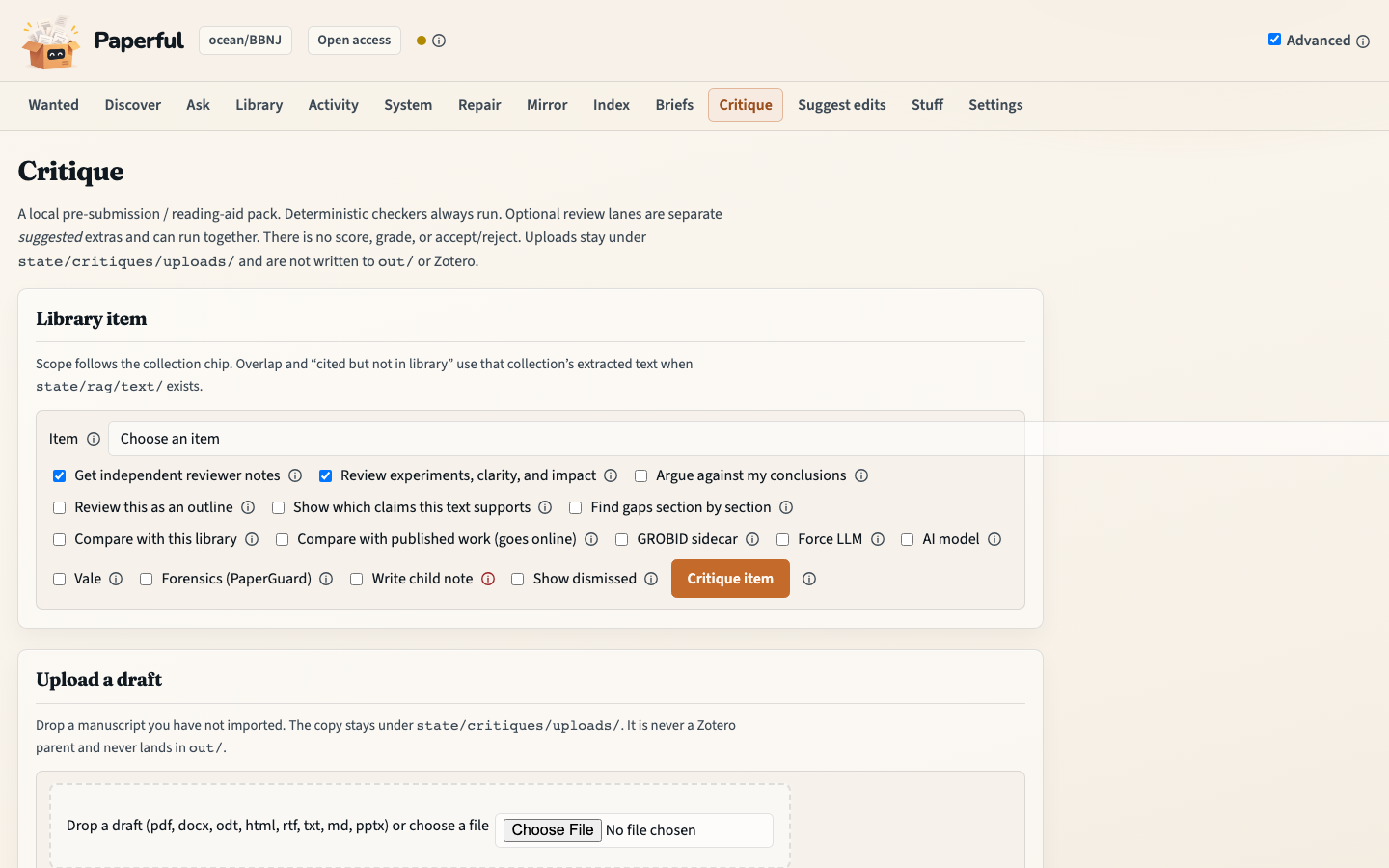
Advanced Critique (not on the default Wanted/Discover/Ask nav): pick an
item from the collection chip or drop a file. Same checkers as the CLI.
When [llm] is on, review-lane checkboxes are labeled by what they return
and can be combined (pre-checked from [critique].lanes, or the llm/advanced
shims when lanes is empty). Visible labels: Get independent reviewer
notes, Review experiments, clarity, and impact, Argue against my
conclusions, Review this as an outline, Show which claims this text supports, Find gaps section
by section, Compare with this library, Compare with published work
(goes online). Tooltips hold the lane ids (reviewers, marg / MARG-S,
adversary, outline, claims, verify — not a truth check, context,
context-web). GROBID sidecar is for MARG-S / claims / verify chunks
(pre-checked from [grobid].enabled).
Library item form also has force-LLM past identity lint. Write child note is --apply (item
only). Show dismissed is --show-dismissed. AI model is --ai-model.
Vale is --vale. The Vale checkbox is not pre-checked; [critique].vale = true still runs the pass even if the box is empty. Forensics (PaperGuard)
is --forensics (same on-switch pattern). Uploads have no apply /
force / dismissed controls. To turn a pack into tracked changes in a copy of
the Word file, use workbench Suggest edits (rewrite;
CLI paperful rewrite).
Config
See [critique] in config.md and config.example.toml.
To turn findings into locatable edits (tracked-changes Word, OpenDocument, PDF, a pptx/odt copy,
sidecar, or an edit list), use rewrite (workbench Suggest
edits).
rewrite never re-runs critique.